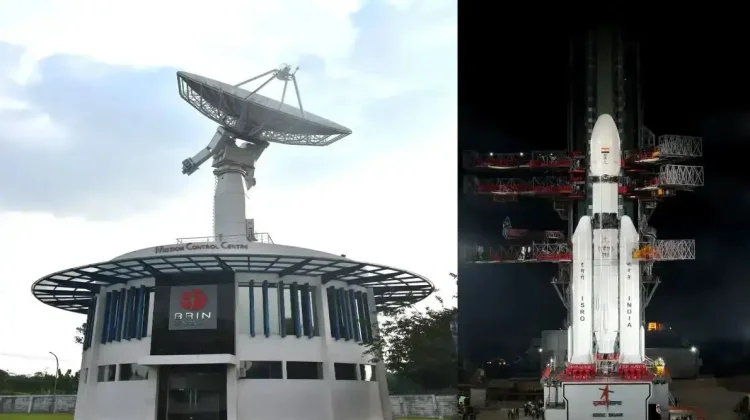
BRIN’s Rancabungur Ground Station monitors India’s LVM3-M6 rocket launch, on Wednesday, December 24, 2025, providing real-time tracking and telemetry...
KBRN, Jakarta: The Indonesian National Research and Innovation Agency (BRIN) has marked another milestone in international space collaboration. The Rancabungur Ground Station in Bogor played a critical role in supporting the launch of India’s LVM3-M6/Bluebird Mission Block 2 rocket, operated by the Indian Space Research Organization (ISRO).
Ade Purwanto, Deputy Head of the LVM3-M6 Rocket Tracking Team, emphasized the precision required in BRIN’s contribution. “Every system functioned flawlessly, and no data was lost during the launch," he said during the launch of the rocket in Bogor, West Java, on Wednesday, December 24, 2025, as quoted on BRIN's official website.
"The teams from BRIN’s Satellite Technology Research Center, Pusdatin, DPLFRKST, along with external partners such as PLN, Telkom, and IconPlus, worked tirelessly to ensure the success of this bilateral cooperation between Indonesia and India,” he addedsaid during the launch event in Bogor, West Java, on Wednesday, December 24.
According to Ade, the achievement underscores Indonesia’s readiness to actively participate in global launch missions and strengthens its position as a strategic partner in the international space ecosystem.
“The LVM3-M6 mission is highly significant for ISRO, requiring cross-station support to ensure optimal Tracking, Telemetry, and Command (TT&C), particularly during the critical early phase of the launch. In this context, Rancabungur Ground Station provided vital TT&C support in line with international standards,” he explained.
Ade highlighted that both Rancabungur and Biak Ground Stations are strategic assets of BRIN, capable of supporting satellite operations and international rocket launches. Indonesia’s equatorial location, he added, offers unique advantages in monitoring specific orbital paths, especially during the initial launch and orbital transition phases.
During the mission, Rancabungur contributed to real-time monitoring of rocket flight parameters and data transmission, with all systems operating according to established technical and safety procedures tested through prior simulations.
“This success demonstrates Indonesia’s readiness to be an active partner in global space activities. It aligns with BRIN’s vision of optimizing national infrastructure to deliver greater scientific, technological, and diplomatic impact,” Ade noted.
The collaboration is part of a long-standing partnership between Indonesia and India in space exploration, dating back to the era of LAPAN and now continuing under BRIN. ISRO has acknowledged the added value of Indonesia’s ground stations in expanding monitoring coverage for launches and satellite operations.
“Working with Indonesia provides strategic advantages for our missions. Although there were initial concerns, they were resolved, and we received complete data without any loss. We see great potential to expand cooperation between ISTRAC and BRIN in the future,” said Anil Kumar, Director of ISRO’s Telemetry, Tracking and Command Network (ISTRAC), in his post-launch remarks in Bangalore, India.
Looking ahead, both sides expect the partnership to evolve beyond launch support, encompassing capacity-building for ground stations, human resource development, and joint research and innovation in space technology.
Ade added that the experience of supporting LVM3-M6 serves as valuable preparation for BRIN’s larger role in the future, including plans to strengthen Indonesia’s ground station network and long-term ambitions to establish a national spaceport.
“BRIN will continue to evaluate and upgrade its ground station facilities, both technologically and operationally. The lessons from LVM3-M6 will guide capacity improvements to support more international missions in the years to come,” he said.
He concluded that the success of Rancabungur Ground Station in supporting the LVM3-M6 launch marks a significant milestone for Indonesia’s space journey. “This achievement proves that Indonesia has the infrastructure, expertise, and commitment needed to play an active role in international space missions.” ***