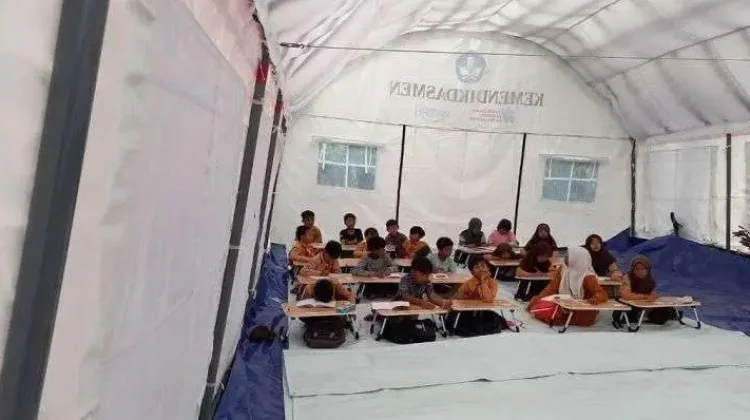
Children study inside a temporary classroom tent provided for students affected by the Sumatra floods. The Ministry of Primary and Secondary Education...
KBRN, Jakarta: The Indonesian Ministry of Primary and Secondary Education (Kemendikdasmen) initiated a rapid-response recovery plan in flood-affected parts of Sumatra on Monday, December 22, 2025.
Currently focusing on Subulussalam City and Aceh Singkil Regency, Aceh, the Ministry is mapping educational requirements and delivering essential aid packages to ensure that the teaching and learning process remains uninterrupted during this emergency period.
To date, the Ministry has distributed emergency tents, 1,005 school kits, and educational funding totaling IDR 450 million (USD 26,831). Of this amount, Subulussalam City received IDR 215 million (USD 12,819) for 28 educational units, while Aceh Singkil Regency received IDR 235 million (USD 14,012) for 24 schools ranging from early childhood centers to Junior High Schools.
Sabariah, the Principal of Jabi-Jabi Public Elementary School (SDN), expressed her deep appreciation for the government's assistance.
"We are very happy to receive this help, our school was previously submerged in mud reaching up to 1.5 meters. We hope that in the future, we receive not only aid but also relocation so that teaching and learning activities can take place more safely," Sabariah said, as quoted by Antara.
The Head of the Aceh Singkil Education Agency, Amran Ramli, praised the direct visit by the Ministry’s Special Staff to the affected sites. He noted that the central government's presence provided morale and certainty for flood-impacted schools, adding that students at Ujung Bawang Public Elementary School were highly enthusiastic about receiving their new school kits.
Yusfitar, the Second Assistant to the Regent of Aceh Singkil, also expressed gratitude for the Ministry's focus on regional education. "It is hoped that school infrastructure can be built better, for example with multi-story buildings, so that if a flood occurs, the teaching and learning process can still continue," he suggested as a disaster mitigation strategy.
Didik Suhardi, the Special Staff to the Minister for Management and Institutional Affairs, explained that disaster response is divided into two phases: emergency response and recovery.
“In the emergency response phase, we ensure that children continue to receive educational services. If offline learning is not yet possible, then online learning or temporary classes via emergency tents are prepared so students can still learn and interact to reduce post-disaster trauma,” Didik explained.
He further noted that during the recovery phase, the Ministry conducts detailed data collection on schools, teachers, and students to plan for facility rehabilitation. “We are mobilizing all existing resource potential so that the educational process can return to normal in a relatively short time,” he added.
Diyah Puspitarini, Chairperson of the Indonesian Child Protection Commission (KPAI), commended the Ministry's rapid and massive response in upholding children's educational rights.
“KPAI witnessed firsthand the Ministry's efforts in ensuring children affected by disasters still get their basic right to education. This fast and comprehensive response is very positive because it involves students, teachers, and educational facilities,” she remarked.
The Ministry remains committed to collaborating with local administrations and stakeholders to ensure educational continuity. Moving forward, they aim to strengthen the preparedness of educational units to better handle potential future disasters. ***





/tcjyrmg4m2jgcrx.png)