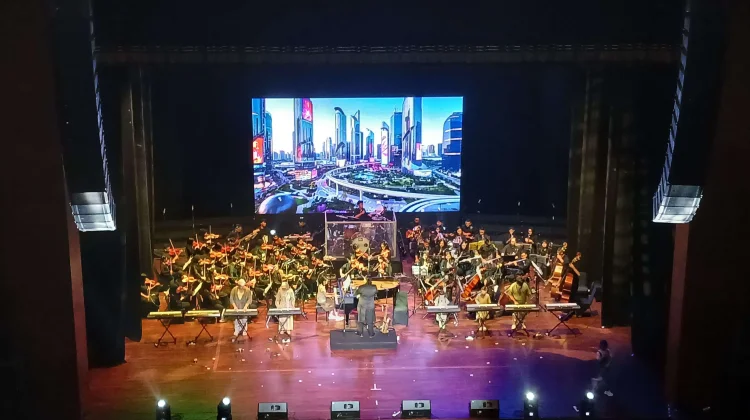
Orchestral performance on KITA Anak Negeri's Musical Concert and Drama "Pintu Bhinneka Tunggal Ika" at Jakarta Theater, Ismail Marzuki Park, Jakarta,...
KBRN, Jakarta: A combined music concert and musical drama was held at Jakarta Theater, Ismail Marzuki Park, Jakarta, on Sunday (12/21/2025). The nearly three-hour performance carried a strong spirit of unity and resistance against authoritarianism.
The Music Concert and Drama Pintu Bhinneka Tunggal Ika ("Bhinneka Tunggal Ika Door") was organized by KITA Anak Negeri, a music school based in Depok, West Java. This marked the fifth time the school has staged the concert, which this year combined orchestra, vocal performances, and drama.
“The Pintu Bhinneka Tunggal Ika concert is highly aligned with the vision and mission of KITA Anak Negeri Music School: to preserve and advance Indonesia’s national culture,” the school stated in a statement.
A child is seen moving along to a song while watching Musical Concert and Drama "Pintu Bhinneka Tunggal Ika" at Jakarta Theater, Ismail Marzuki Park, Jakarta, Sunday (12/21/2025). (Photo: RRI VOI/Rama Shidqi Pratama)
Pintu Bhinneka Tunggal Ika tells the story of a country called Ika, which has two cities, Bhinna and Tunggal. A door gate separates the two in a discriminatory way: Tunggal residents are allowed to enter Bhinna through the gate, but not vice versa. The only Bhinna residents permitted to pass through the gate are state servants of the Ika government, led by King Andaka.
Bhinna people wishing to become state servants must undergo Training on the Five Insignia. During the training, candidates are introduced to five fundamental national values known as the "Five Insignia": tolerance, human rights, unity, collective decision-making, and sacrifice.
Only a small number of Bhinna residents are able to be the officials, but when registration opens, many apply. One of them is Taraswin, a girl who dreams of becoming a leader and opening access to the gate for everyone, including Bhinna people. The participants eventually undergo the Five Insignia Training under the guidance of Dr. Solana as their teacher.
Dr. Solana, played by Evi Raswandi, taught children participants of "Training on the Five Insignia" in an act of Musical Concert and Drama "Pintu Bhinneka Tunggal Ika" at Jakarta Theater, Ismail Marzuki Park, Jakarta, on Sunday (21/12/2025). (Photo: RRI VOI/Rama Shidqi Pratama)
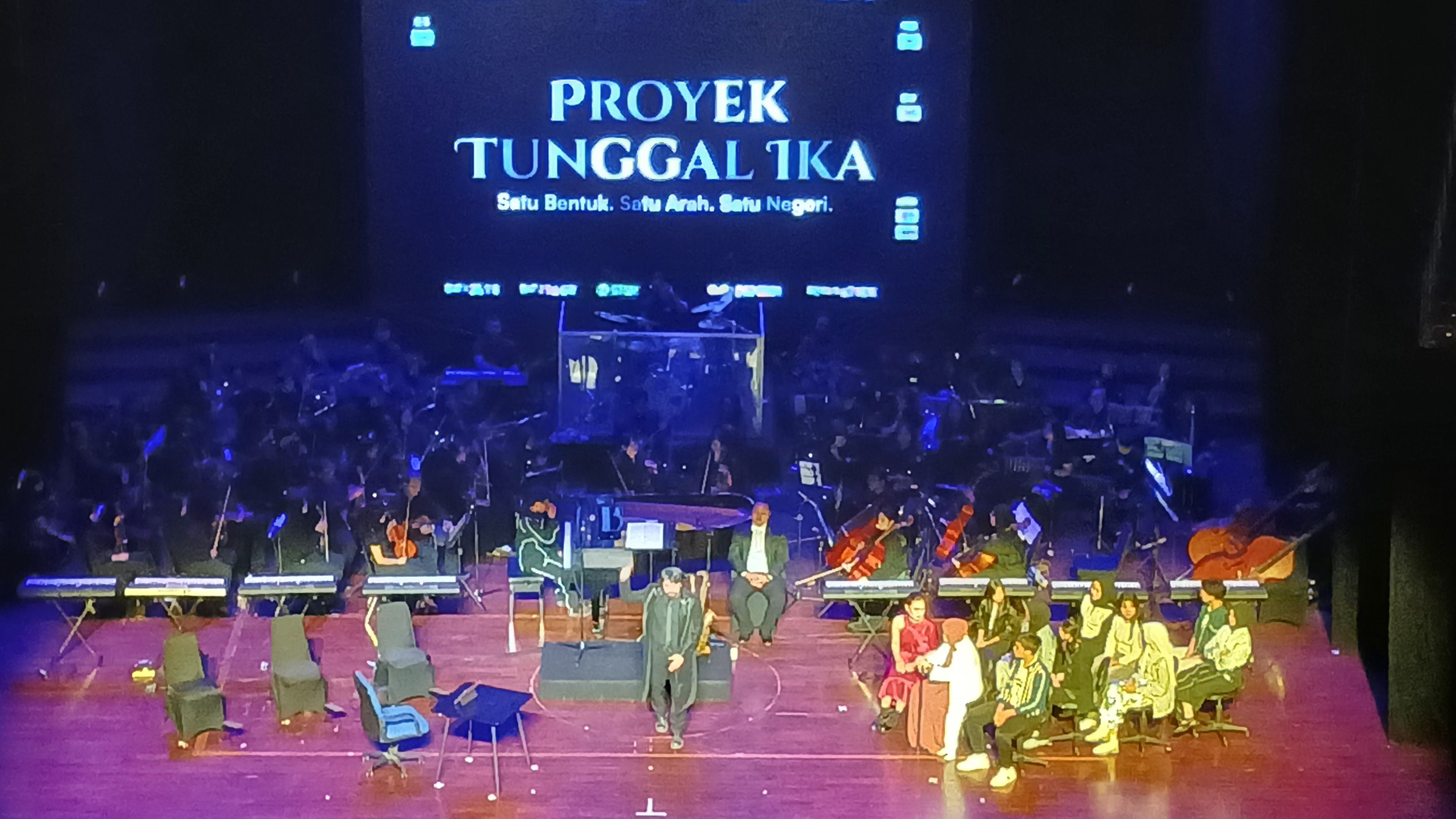
Twelve years later, King Andaka summons the participants. However, he arrives with the “Tunggal Ika Project,” an authoritarian initiative that centralizes the nation’s values and direction around himself.
"(The project is) A comprehensive social transformation for complete stability. A future without noise, without deviation," the king declares.
The Tunggal Ika Project stands in opposition to the Five Insignia values, promoting "guided uniformity, rights adjusted to function, functional unity, efficient decision-making, and measured sacrifice". Furthermore, according to King Andaka, human rights need not be granted to those who "only become a burden on the state".
Taraswin and Dr. Solana immediately resist, attempting to persuade the king while simultaneously spreading a recording of the project announcement throughout the country. Ultimately, following public pressure that demonstrated unity across diverse backgrounds, King Andaka canceled the project and withdrew his statement.
King Andaka, played by Amboro, introduces Tunggal Ika Project in an act of Musical Concert and Drama "Pintu Bhinneka Tunggal Ika" at Jakarta Theater, Ismail Marzuki Park, Jakarta, on Sunday (12/21/2025). (Photo: RRI VOI/Rama Shidqi Pratama)
The drama was interspersed with performances of up to 16 Indonesian songs, some of which were not directly connected to the storyline. Nevertheless, every performance by KITA Anak Negeri students drew enthusiastic applause from the approximately 900-member audience.
The songs include traditional ones, such as Papuan Sajojo telling a beautiful girl adored by many, and Javanese children's game song Cublak-Cublak Suweng. Others are modern pop songs, such as Ismail Marzuki's Payung Fantasi (Umbrella of Fantasy), a song about a man seducing a woman by asking her. At the end, patriotic songs were played, such as Chrisye's Negeriku (My Country), Gombloh's Kebyar-Kebyar, and the drama's soundtrack Pintu Bhinneka Tunggal Ika.
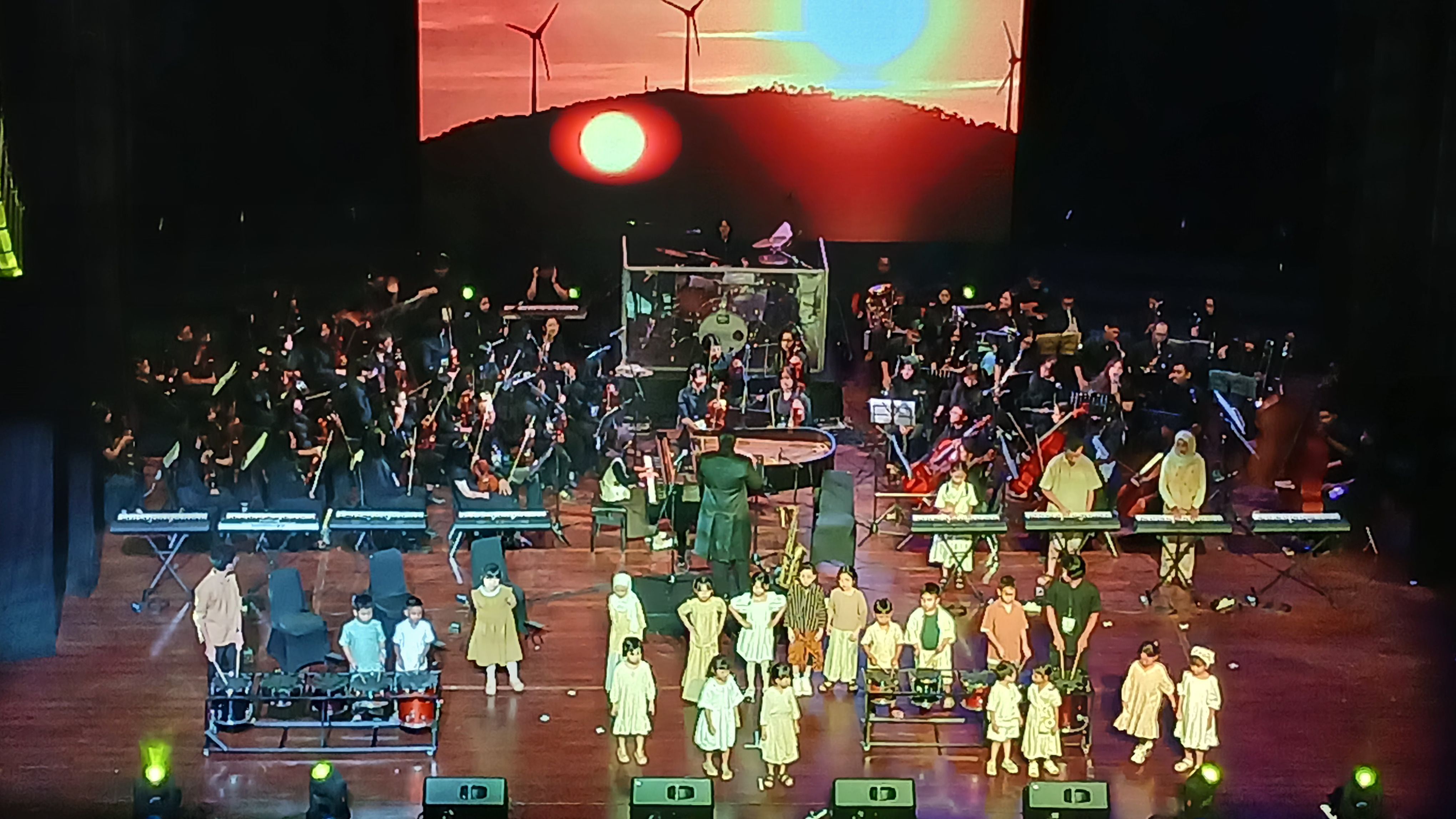
Childrens performed an Indonesian kids song Aku Anak Gembala (I'm a Shepherd's Child) on KITA Anak Negeri's Musical Concert and Drama "Pintu Bhinneka Tunggal Ika" at Jakarta Theater, Ismail Marzuki Park, Jakarta, on Sunday (21/12/2025). (Photo: RRI VOI/Rama Shidqi Pratama)
The phrase Bhinneka Tunggal Ika in the concert’s title refers to Indonesia’s national motto, which appears on the country’s state emblem of Garuda Pancasila. The Sankrit term roughly translates as "it is different, (yet) it is one", and can be interpreted as "unity in diversity".
The term is quoted from an Old Javanese poem Sutasoma, written by Mpu Tantular in the 14th-century Majapahit Empire. The verse in which the term can be found teaches tolerance between Shivaite Hindus and Buddhists, the two predominant faiths in the empire.







/z70hv7om6a02gfi.png)