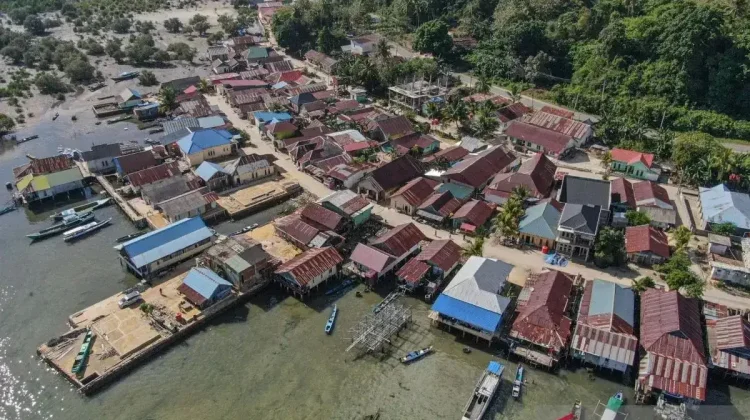
File Photo - An aerial photo of a "rainbow village" in Nambo Subdistrict, Kendari, Southeast Sulawesi. The Ministry of Housing and Settlement Areas (P...
KBRN, Jakarta: The oil and gas industry is being hailed as a potential "economic engine" capable of transforming the lives of Indonesia’s coastal communities.
However, experts warn that this potential can only be unlocked through a radical shift toward local hiring, transparent profit-sharing, and environmental accountability.
Aceng Hidayat, an environmental economist from IPB University, argued on Tuesday, December 30, 2025, that the industry’s benefits have historically bypassed those living nearest to extraction sites.
To address this, he advocates focusing on the "missing middle," technical-vocational (SMK) graduates who often lack the specialized certifications required for high-skill energy roles.
"The main gateway for the oil and gas industry to have a real impact is absorbing local labor, especially vocational high school (SMK) graduates and the middle class," Aceng stated in Jakarta, as quoted by Antara.
He proposed that investors collaborate to build fast-track training centers that could certify local technicians within months, ensuring that the economic gains from the energy sector flow directly to seaside households.
The debate over the industry's contribution must also move beyond tax revenue. Aceng emphasized the need for clarity on "profit-sharing" schemes. The actual cut the state receives from every barrel extracted.
He argues that these funds should be reinvested directly into the host regions to secure basic needs, such as access to clean water, breathable air, and viable living spaces.
To prevent communities from becoming overly dependent on a finite resource, the expert also called for economic diversification. By integrating industrialization in energy with traditional coastal strengths, such as seaweed cultivation, modern fisheries, and marine tourism, the government can build a more resilient local economy.
While the economic case is strong, the environmental challenges remain. Komaidi Notonegoro, Executive Director of the ReforMiner Institute, noted that while the oil and gas sector is physically less invasive than open-pit coal or mineral mining, it is not without risk.
"Oil and gas are extracted as liquids, while minerals and coal require land clearing and large amounts of solid material," Komaidi explained. He acknowledged that while zero-impact extraction is impossible, responsible management can minimize the footprint.
"The impact can be minimized, and there are already examples of this in practice," he added, urging companies to adopt the latest sustainable technologies as they expand into Indonesia's vast coastal regions. ***