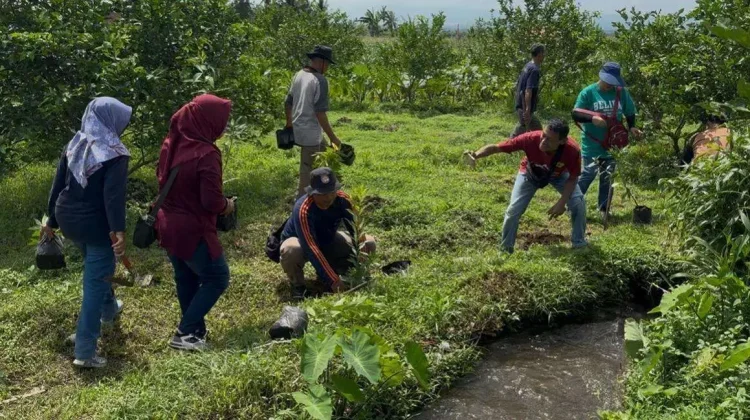
Sumbang Village, Banyumas Regency, Central Java, develops an integrated zero-waste organic farm named 'Kota Nila' (Nila City). (Photo: RRI/Damara)
KBRN, Banyumas: The administration of Sumbang Village in Banyumas Regency, Central Java, is intensifying its efforts toward sustainable agriculture as a primary pillar of village self-sufficiency. Utilizing eight hectares of village-owned land, the local administration, in collaboration with the Village-Owned Enterprise (BUMDes), has initiated the development of an integrated zero-waste organic farm name Kota Nila (Nila City).
Sumbang Village Head Sunarko explained that Kota Nila is a comprehensive organic farming hub managed entirely by BUMDes. The program is strategically designed to integrate the agriculture, plantation, and livestock sectors into a sustainable loop that generates zero waste.
“Kota Nila is a zero-waste integrated organic farm covering approximately eight hectares in Sumbang Village. All management activities will be carried out by BUMDes,” said Sunarko on Monday, December 29, 2025.
He further clarified that the organic farm does not focus on a single commodity. Currently, a portion of the land has been planted with lemon trees, which are intended to serve as a future food source for honeybees.
The site also features avocado trees and various other agricultural products that are being developed in stages. “Beyond lemons, we have avocados here, and we plan to plant various other types of vegetation, including food crops,” added Sunarko.
Moving beyond plant-based agriculture, Nila City is set to include livestock units. Among these is a poultry farm integrated into the larger agricultural system to support the zero-waste concept. Regarding the honeybee project, Sunarko noted that the current priority is the preparation of forage plants, with bee colonies to be introduced once the food source is deemed sufficient.
While the land was previously utilized for lemons and avocados, future expansion will include a wider variety of crops, such as soybeans and other agricultural commodities that align with the integrated farming model. The local administration hopes this initiative will serve as a blueprint for sustainable rural development. (Annaila Azzahra/Sri Wahyuni)





/dm1fitkusonnmbr.jpeg)