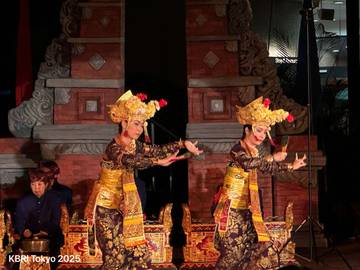
Anak Agung Rai Bintang Febrianti (right) performs as a sisya dancer in the Calonarang drama at the Dalem Payogan temple in Ubud, Bali. The performance...
KBRN, Gianyar: The Calonarang dance drama was performed by the young men and women of Banjar Payogan, Kedewatan Village, Ubud, Gianyar, on December 28, 2025, as a form of ngayah. The performance reflected their commitment to preserving Balinese arts, customs, and culture.
Ngayah is a Balinese term that refers to voluntary and sincere service, carried out without ulterior motives, particularly for traditional, religious, or social activities at temples, banjar (traditional villages), and for the common good.
According to Anak Agung Rai Bintang Febrianti, 22, one of the sisya dancers, students who portray the mystical disciples in the Calonarang performance, the involvement of the younger generation is an expression of devotion to Ida Sang Hyang Widhi Wasa and the indigenous community. “This is our responsibility as the younger generation, to express our devotion to God,” she said.
Despite the pressures of modernization, the ngayah spirit of Payogan’s youth remains strong. They dedicate their time and energy to rehearsing and performing the sacred Calonarang drama. “We’ve been practicing for a month, rehearsing four times a week so as not to interfere with our friends’ school activities,” Febrianti explained.
The mystical elements of the Calonarang performance continue to captivate audiences in Bali. Steeped in sacred values, the drama is believed to contain unseen powers. “There’s a sense of fear when acting as a sisya. Perhaps it’s because we immerse ourselves in the role, as sisya is synonymous with magic,” Febrianti said, sharing her experience.
She added that a ritual is performed before each show. “We ask for safety from the Sesuhunan, our ancestors and gods, so the performance runs smoothly. According to our beliefs, Calonarang transforms negative energy into positive energy, which is why it carries mystical elements,” she said.
Calonarang is based on the legend of a powerful female sorceress from 12th-century Javanese-Balinese tradition.
The story has been adapted into a renowned dance drama that depicts the struggle between good, represented by Barong, and evil, embodied by Rangda or Calonarang. Beyond its spectacle, the performance symbolizes female power in the arts and serves as a ritual to cleanse negative energy.
The drama is regarded not only as entertainment but also as a source of guidance for life, teaching the balance between good and evil, self-control, and respect for the forces of the universe. Its mystical elements ensure that Calonarang remains a sacred and meaningful part of Balinese cultural heritage.
After the performance, Febrianti hopes more young Balinese will participate in artistic performances as dancers or musicians rather than simply as spectators. “We must have the spirit of preserving the arts. It is also a form of devotion to Ida Betara Sesuhunan,” she said.
For the younger generation, ngayah is both an act of devotion and a medium for learning. Through the Calonarang performance, they gain lessons in togetherness, discipline, and respect for Bali’s noble traditions. “I hope that the younger generation in Bali will always preserve art and culture. Even in modern times, traditional art must remain alive and thriving,” Febrianti added. (Misni Parjiati/Lasti Martina)