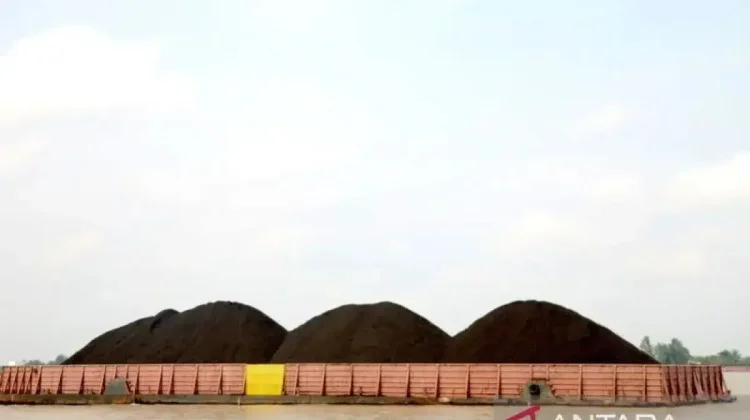
File Photo - A barge carries coal along the waters of Banjarmasin, South Kalimantan, December 18, 2025. The image comes amid Indonesia’s plan to reint...
KBRN, Jakarta: Indonesia’s plan to reintroduce a coal export levy in 2026 is being framed not only as a fiscal measure to boost state revenue, but also as a corrective step to address long-standing problems of trade misinvoicing that have eroded government income.
Senior Analyst at NEXT Indonesia Center, Sandy Pramuji, said in Jakarta on Tuesday, December 30, 2025, that the levy could serve as a crucial instrument to close loopholes in export reporting practices that have cost the state significant revenue.
“The coal export levy will force synchronization of data and act as a stricter cross-check between production, sales, and export volumes, thereby reducing opportunities for manipulation in the future,” Sandy explained, as quoted by Antara.
He noted that despite Indonesia’s position as the world’s largest coal supplier, with exports totaling 1.8 billion tons between 2020 and 2024, the sector has been plagued by misinvoicing. This practice involves reporting export values lower than actual international market prices, depriving the state of substantial income.
According to Sandy, misinvoicing is not merely an administrative error but a deliberate scheme with direct consequences for national finances. He argued that reinstating the coal export levy would serve a dual fiscal role: expanding the revenue base while enforcing discipline in trade reporting to ensure consistency across production, sales, and export data.
Earlier, NEXT Indonesia Center’s Head of Research and Public Policy Analyst, Ade Holis, estimated that the levy could generate around IDR 19 trillion in additional revenue within a single fiscal year once implemented in January 2026.
The projection, based on the Center’s research, excludes lignite, classified under HS code 2702, considered the lowest-grade coal. Ade clarified that the simulation only accounted for coal and briquettes under HS code 2701. “If lignite were included in the levy, the potential revenue would be even greater,” he said in a recent statement.
The government’s plan marks a revival of the coal export levy after nearly two decades of exemption. The last time such a levy was imposed was in 2005–2006. Ade emphasized that the policy is intended not only to strengthen state revenue but also to end what he described as a “coal subsidy” in the form of export duty exemptions. ***