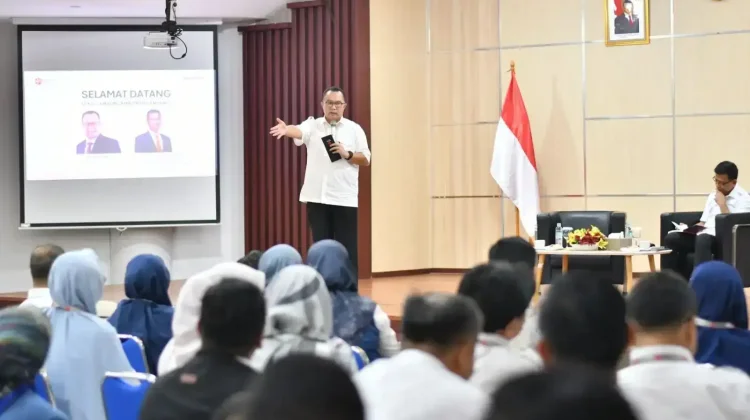
BRIN Head Arif Satria examines AI-powered remote sensing technology at the Samaun Samadikun Science and Technology Center in Bandung, December 24, 202...
KBRN, Jakarta: The Indonesian National Research and Innovation Agency (BRIN) is accelerating the use of AI in remote sensing to turn satellite imagery into actionable data, officials said on Thursday, December 24, 2025.
Head of BRIN’s Samaun Samadikun Science and Technology Center, Arif Satria, highlighted its potential for faster, more precise insights in disaster management, agriculture, and industry.
“I need a new approach based on AI and advanced technology so that our independence in remote sensing can be stronger,” Arif said, on Wednesday, December 24, as quoted on BRIN’s official website.
He urged an acceleration in the use of AI for processing satellite imagery, noting that the technology enables faster and more precise analyses, including for disaster management. Arif cited the United Nations Development Program’s 3D AI modeling as a tool that can facilitate effective overlay analyses before and after disasters.
“Satellite imagery should not just capture pictures but be able to directly interpret analytical insights,” he added.
Arif stressed that AI research is inherently multidisciplinary, spanning remote sensing, computing, electronics, telecommunications, intelligent mechatronics, and data science.
He called for collaboration between BRIN’s Electronics and Informatics Research Organization (OREI) and other research units to mainstream AI, aiming to accelerate OREI-BRIN’s 2026 research agenda.
During the visit, Arif encouraged BRIN researchers to deepen their studies and focus on projects that are relevant to societal needs. He emphasized the importance of robust research infrastructure, noting that the progress of a nation is measured by its technological and research capabilities.
“The nation’s advancement is measured by technological progress, technological progress is measured by research, and research is reflected in research facilities and themes,” Arif said.
He also underscored that strategic research must be user-oriented. Close interactions between researchers and end-users, such as farmers and industries, are vital to ensure research outcomes drive industrial development and deliver tangible societal benefits.
“Research agendas must align with user needs, which requires active engagement with users,” he added.
Beyond remote sensing, Arif highlighted national research priorities in energy, water, health, agriculture, and disaster management. He also pointed out BRIN’s role in strengthening Indonesia’s electronics industry, urging electronics researchers to understand the broader industrial competitiveness landscape.
“What is the competitive landscape of our electronics industry, its market, and which information can become national innovation?” he asked.
Arif encouraged researchers to maintain focus in their respective fields while fostering interdisciplinary collaboration. He expressed confidence that BRIN, with its facilities and expertise, can become a cornerstone of national research strength.
“I am confident that after seeing BRIN’s facilities and the expertise of our researchers, BRIN can truly become a national powerhouse,” he explained. ***
Prior to visiting KST Samaun Samadikun, Arif and his delegation toured PT Dirgantara Indonesia (PT DI) to review the development of the N219 aircraft and other designs. He expressed optimism that products from BRIN-PT DI collaborations will contribute to the revival of Indonesia’s aerospace industry.
BRIN Deputy Head Amarulla Octavian noted that the visit was part of ongoing follow-ups from previous site visits, including PT DI. He said several decisions on future research, particularly in aviation and electronics-informatics, have been prepared.
“As directed by the head of BRIN, our focus is on research that is urgently needed and whose results can be immediately felt by society,” Amarulla said. ***






/s9q9befqn5s4ikx.png)