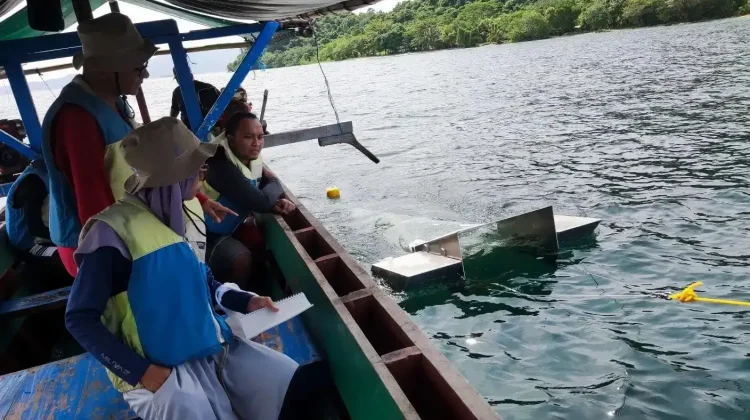
Microplastic sampling in seawater with a Manta Net is conducted under IAEA protocols. Through NUTEC Plastics, Indonesia has joined the IAEA initiative...
KBRN, Jakarta: Indonesia is stepping up efforts to confront marine microplastic pollution, joining more than 100 countries in the Nuclear Technology for Controlling Plastic Pollution (NUTEC Plastics) program led by the International Atomic Energy Agency (IAEA).
Through the National Research and Innovation Agency (BRIN), Indonesia is helping establish standardized global monitoring protocols.
Microplastics, plastic particles smaller than five millimeters, are now found across nearly all marine ecosystems. Yet data comparisons between countries remain inconsistent due to varied research methods. BRIN’s involvement aims to close this gap.
Ali Arman, Principal Researcher at BRIN’s Radiation Process Technology Research Center, explained that Indonesia’s participation stems from an international mandate. “Previously, we did not have a monitoring program with standardized protocols,” he said on BRIN's official website.
Indonesia contributes to two projects: the Asia-Pacific program (RAS 7038) focused on marine monitoring, and the global initiative (INT 7021) building a worldwide coastal microplastic database. Initial sampling began in 2024 in Lampung and other sites, using agreed protocols such as ATR-FTIR analysis. Data is uploaded to IAEA’s IRIS platform for public access.
This monitoring phase lays the foundation for advanced research. Between 2026 and 2029, nuclear techniques will be introduced to trace historical accumulation. BRIN plans to apply lead-210 (Pb-210) dating to reconstruct pollution records in sediments up to 150 years back.
“Nuclear technology allows us to see when pollution began and how it evolved,” Ali noted.
Beyond environmental mapping, BRIN is studying microplastics in marine organisms and their risks to humans. Researcher Heny Suseno uses nuclear tracing by labeling microplastics with iodine-131 (I-131) and tracking their movement in live test species such as fish and shellfish. Gamma spectrometers monitor accumulation without harming the animals.
“The advantage of nuclear technology is that we can analyze living organisms continuously,” Heny explained.
This approach enables calculation of bioaccumulation factors, residence times, and distribution in specific organs, offering insights into potential human exposure through seafood consumption.
Supported by BRIN’s Research and Innovation for Advanced Indonesia (RIIM) scheme and collaborations with universities including the University of Indonesia (UI), findings have been published in reputable journals.
By combining environmental monitoring, historical reconstruction, and bioaccumulation studies, Indonesia is building a comprehensive framework to understand marine microplastic pollution.
Nuclear technology complements conventional methods, providing critical insights into contamination timelines and risks to human health, positioning Indonesia as a key contributor to global solutions. ***





/s9q9befqn5s4ikx.png)