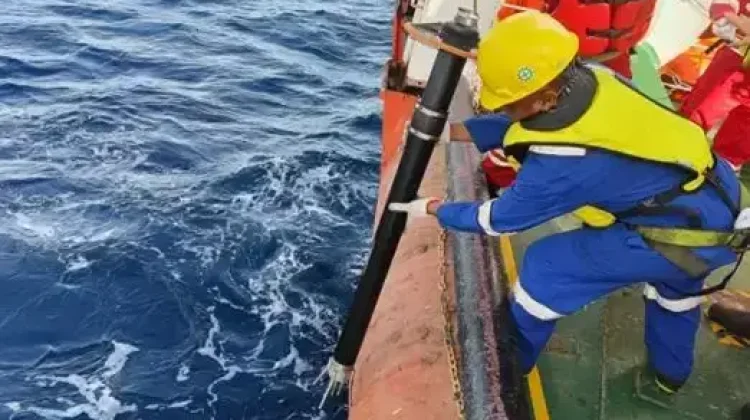
A researcher from the IMPOLSE 2025 expedition, jointly conducted by BRIN and IOCAS, participates in the team’s landmark achievement of successfully re...
KBRN, Jakarta: The marine research collaboration between the Indonesian National Research and Innovation Agency (BRIN) and the Institute of Oceanology, Chinese Academy of Sciences (IOCAS) has marked a new milestone in the exploration of the Indonesian ocean.
Through the Indonesia Maritime and Pacific Ocean Long-term Scientific Expedition (IMPOLSE) 2025, scientists successfully retrieved a high-frequency deep-sea mooring for the first time.
The expedition ran from November 25 to December 30, 2025, using the Geomarin III survey vessel owned by the Center for Marine Geology Survey and Mapping (BBSPGL), the Indonesian Ministry of Energy and Mineral Resources (ESDM). This achievement opens a new chapter in the observation of fast ocean phenomena such as solitary internal waves, which have been challenging to detect.
BRIN's IMPOLSE Cooperation Coordinator, Adi Purwandana, emphasized the importance of this new approach. “From preliminary data in the Maluku Sea, the amplitude of solitary internal waves, which was originally estimated at 40-80 meters, now reaches more than 100 meters,” said Adi in Jakarta on Monday, December 22, as quoted by BRIN.
He added that these results are comparable to the maximum amplitude in the Lombok Strait and demonstrate the high accuracy of the latest mooring system. This innovation is a significant breakthrough for national oceanographic studies.
IOCAS researcher Zheng Wang believes that this collaboration has strategic significance for strengthening regional marine research. “The BRIN-IOCAS collaboration realizes the vision of Golden Indonesia 2045 and the Belt and Road Initiative, placing both countries at the forefront of Indonesian Throughflow research,” he said.
The expedition, which has been ongoing since 2014, is the eighth collaboration between the two institutions. This year, high-frequency mooring replaced the old system that still worked at low frequencies, improving the accuracy of observations.
The first phase of the expedition took place in the north of the Lombok Strait, the Labani Channel, and the Western Maluku Sea, while the second phase continued to the Eastern Maluku Sea and the Lifamatola gap. Measurements were taken using a Vertical Microstructure Profiler (VMP) and Conductivity Temperature Depth (CTD).
In addition to focusing on deep ocean dynamics, the team also researched microplastics, biofouling, and the microbiology of marine plastic degradation. Students from the University of Chinese Academy of Sciences (UCAS), Bogor Agricultural University (IPB), and Bandung Institute of Technology (ITB) also participated to develop their capacity and transfer technology.
BRIN and IOCAS hope that the results of IMPOLSE 2025 will form the scientific basis for sustainable marine resource management and the development of regional climate models. This high-resolution data is expected to strengthen Indonesia's position in the global oceanography research map. ***