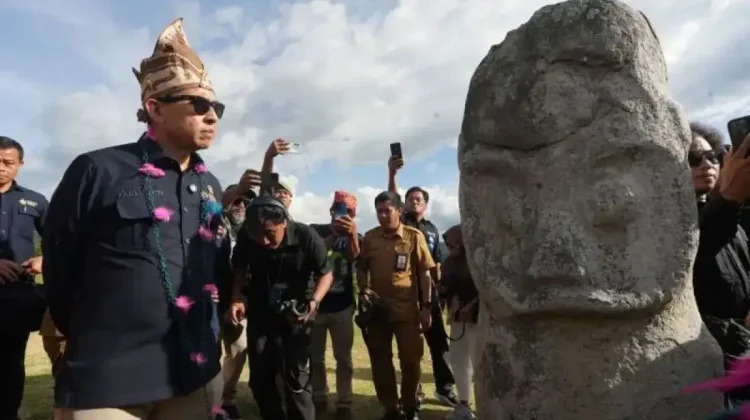
Indonesian Minister of Culture Fadli Zon inspects cultural heritage sites in the Lore Lindu megalithic area, Poso Regency, Central Sulawesi, Tuesday,...
KBRN, Poso: The mist-shrouded highlands of Central Sulawesi have taken center stage in Indonesia’s cultural preservation efforts as the government moves to protect one of the oldest civilizations in the Malay Archipelago.
Indonesian Minister of Culture Fadli Zon has called for a rigorous, sustainable management framework for the megalithic sites within the Lore Lindu area, asserting that these ancient relics are definitive proof of a sophisticated prehistoric society that predates many known civilizations in the region.
During a high-profile cultural expedition on Tuesday, December 30, 2025, Minister Fadli visited several key archaeological landmarks, including the Tadulako, Pokekea, and Tambi sites.
The visit serves as a strategic commitment to ensure that these national treasures are not only preserved but also utilized responsibly for historical and cultural tourism.
"We must protect, develop, and utilize this wealth responsibly as a cultural and historical tourism destination, without neglecting the principle of preservation," the Minister stated, as quoted by Antara, highlighting the delicate balance between public access and conservation.
The archaeological significance of Lore Lindu is staggering. Scientific estimates suggest that the stone structures and carvings in the area date back over 4,000 years, with some findings potentially reaching as far back as 8,000 years.
This timeline positions Central Sulawesi as a pivotal cradle of Nusantara civilization. At the Pokekea Megalithic Site, a nationally ranked cultural heritage area, vast grasslands are dotted with remarkable artifacts, including stone statues (arca), massive stone vats (kalamba), dolmens, and ancient pottery fragments.
These remnants indicate that the area once served as a complex hub for settlement, burial, and ritualistic worship.
"The archaeological remains in this area are over 4,000 years old, and in some locations, they are estimated to be up to 8,000 years old. This shows that Central Sulawesi was an important part of the ancient Indonesian civilization," Minister Fadli remarked during his inspection of the Pokekea site.
He emphasized that the sheer variety of artifacts, from perforated stones to intricate lids for stone vats, demonstrates an advanced level of engineering and social organization for that era.
Despite their historical grandeur, the sites face modern threats. The Minister raised concerns over potential vandalism and the accelerating effects of climate change, which can lead to the weathering and deterioration of the ancient stone structures.
To combat this, the Ministry of Culture plans to elevate the global profile of Lore Lindu while intensifying scientific research.
"As it has been nationally recognized, we hope the Pokekea Cultural Heritage Site will become increasingly well-known to the public, and we will promote it not only to the people of Central Sulawesi and the Archipelago, but also to the world," he added.
Looking ahead, the Ministry is committed to fostering a new wave of archaeological research to uncover the deeper mysteries of the prehistoric communities that once thrived in these highlands. By integrating conservation with modern academic inquiry, the government aims to strengthen Indonesia’s cultural identity and provide a window into a past that remains etched in stone.
"Going forward, our challenge is to conduct further research so that past civilizations in this region can be revealed in greater depth," the Minister concluded, reaffirming that the riches of Lore Lindu are a testament to a civilization that is as profound as it is ancient. ***