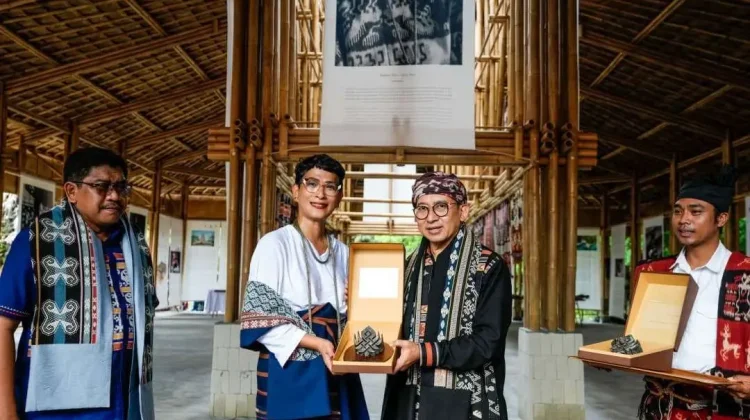
Oscar Lawalata (left), founder of the Umaratu Foundation, and Minister of Culture Fadli Zon (right) attend the inauguration of the Umaratu Foundation'...
KBRN, Jakarta: On December 27, 2025, Rumah Ibu Bumi, a cultural center established by the Umaratu Foundation, was inaugurated.
The event highlighted the enduring legacy of tenun Sumba, one of Indonesia’s most celebrated traditional textiles, renowned for its intricate motifs and deep cultural symbolism.
Minister of Culture Fadli Zon expressed hope that Rumah Ibu Bumi would serve as a cultural enclave in East Sumba, providing space for learning and inspiration, particularly for younger generations.
“Public spaces like this are expected to become cultural enclaves where the Umaratu Foundation can nurture knowledge and creativity, especially among the youth,” he said during the inauguration, as reported by Antara.
In a press release issued in Jakarta the following day, Fadli described the inauguration as a milestone in advancing Indonesian culture.
He emphasized that activating Rumah Ibu Bumi is vital to preserving traditional textiles and driving the creative economy rooted in local wisdom. “This is where local wisdom is passed down, culture is showcased, skills and entrepreneurship are promoted, and national identity is strengthened,” he said.
The minister noted that the Ministry of Culture has collaborated with local administrations, private institutions, cultural communities, and individuals to promote cultural advancement.
He also praised the women weavers and cultural practitioners who have successfully introduced Sumba textiles to the global stage. “These fabrics are already recognized worldwide. They are in the hands of international collectors, displayed in museums, and sold in shops across regions,” he added, underscoring the potential of Sumba textiles as instruments of cultural diplomacy.
Ahmad Mahendra, Director General of Cultural Development, Utilization, and Guidance at the ministry, said that revitalizing cultural buildings, such as Rumah Ibu Bumi, can bring new hope to cultural practitioners in surrounding communities.
Tenun Sumba, or Sumba woven itself, is regarded as a masterpiece of Indonesian textile heritage. Crafted by skilled hands on Sumba Island, each woven thread represents not only clothing but also life, belief, and cultural identity.
The weaving process is long and complex, often taking months, as artisans use traditional looms and natural dyes derived from plants.
The beauty of tenun Sumba lies in its distinctive motifs: horses, birds, skulls, and natural symbols, each carrying philosophical meaning. These motifs serve as a visual language that records the relationship between humans, nature, and ancestors.
Within Sumbanese society, the fabric holds a special place: worn during traditional ceremonies, used as dowry, and regarded as a marker of social status.
The tradition of ikat weaving in Sumba has existed for centuries, passed down primarily through women. It is not merely a technical skill but a social and spiritual practice embedded in daily life.
Cultural records indicate that Sumba textiles have long been renowned, long before they gained recognition abroad. Women weavers oversee the entire process, from selecting motifs and preparing threads with natural dyes to weaving the final cloth.
A single wide textile can involve up to 42 stages of work and take four to six months to complete.
The inauguration of Rumah Ibu Bumi thus not only provides a new cultural space in East Sumba but also reinforces the significance of tenun Sumba as a living heritage. This art form continues to inspire, empower, and connect Indonesia to the world. ***