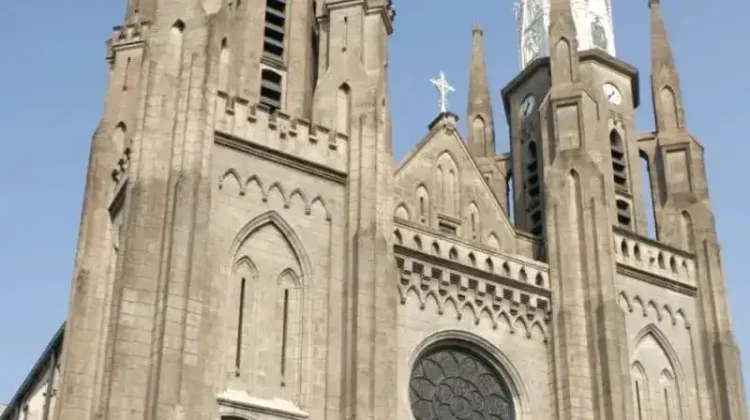
The exterior of Jakarta Cathedral (Photo: Katedraljakarta.or.id)
KBRN, Jakarta: Jakarta Cathedral is not merely a place of worship, but also a historical and cultural site and a symbol of interfaith harmony amid the capital’s dynamic life. Officially known as the Church of the Assumption of the Blessed Virgin Mary, the building stands as one of Jakarta’s most magnificent neo-Gothic architectural icons.
As one of the oldest churches in Jakarta, the cathedral has a long and rich history. The presence of the Catholic Church in Batavia dates back to the early 19th century. Initially, the first church was a modest structure in the Lapangan Banteng area and relocated several times before the permanent neo-Gothic building, now known as Jakarta Cathedral, was constructed.
The church was inaugurated on April 21, 1901, and consecrated by Mgr. Edmundus Sybrandus Luypen, SJ. Since then, it has served as the center of Catholic activities in Jakarta.
Designated as a national cultural heritage site in 1993, the cathedral functions not only as a place of worship, but also as a witness to the historical journey of the Catholic community in Indonesia. Its location directly opposite Istiqlal Mosque has made the area a living symbol of religious diversity and tolerance in the country.
Within the Jakarta Cathedral complex, a museum preserves various historical artifacts related to the development of Catholicism in Jakarta. These include documents, photographs, and other historical objects that record the journey of the Catholic community in the city.
The museum is open to the public and serves as an educational space on Indonesia’s religious cultural heritage. One of the cathedral’s unique features is the presence of two pipe organs with high historical and artistic value.
The Verschueren organ, brought from Belgium in 1988, consists of 15 registers and approximately 1,000 pipes, specially installed by Belgian engineers to match the church’s neo-Gothic architecture.
In addition, there is an older organ from Stuttgart, Germany, with around 400 pipes. This organ was used during the cathedral’s inauguration in 1901 and is still maintained as part of the church’s musical heritage.
Both organs are often played during special Masses and liturgical music events, producing distinctive sounds that enrich the spiritual experience of worshippers.
A tangible manifestation of interfaith harmony in central Jakarta is the Terowongan Silaturahmi, or Tunnel of Friendship, which connects Jakarta Cathedral with Istiqlal Mosque. The underground passage, measuring approximately 28 to 33 meters in length, was built starting in late 2020 as part of the Istiqlal Mosque renovation.
The tunnel project was inaugurated on December 12, 2024, by President Prabowo Subianto as a symbol of brotherhood and Indonesia’s diversity. Beyond its symbolic meaning, the tunnel also facilitates the movement of worshippers at both places of worship and helps ease traffic congestion during major religious celebrations such as Christmas and Eid al-Fitr.
The tunnel walls are adorned with an art installation titled “Wot Hati” (Bridge of Hearts) by an Indonesian artist. The artwork depicts connectivity and communication among different religious communities, reinforcing the message of tolerance amid diverse beliefs.
With its historical value, architectural beauty, and dual function as a place of worship and educational destination, Jakarta Cathedral continues to attract local residents and tourists alike. Its presence reflects a spirit of tolerance embodied in its harmonious relationship with Istiqlal Mosque across the street, offering a vivid representation of Bhinneka Tunggal Ika in Jakarta.