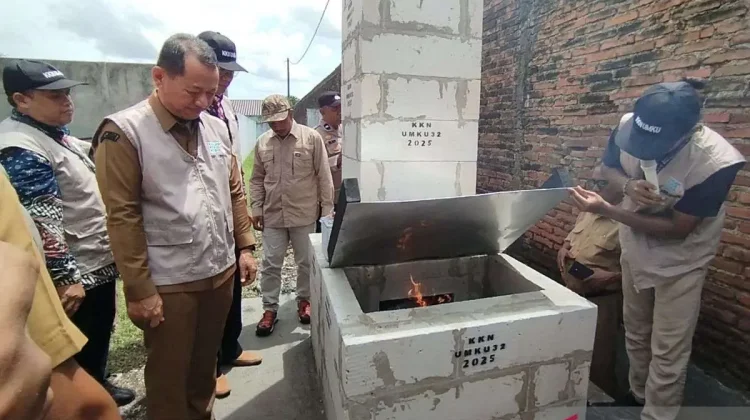
Kudus Regent Sam’ani Intakoris, accompanied by UMKU Rector Edy Soesanto, Karangbener Village Head Arifin, and Kudus Regency Councilor Sandung Hidayat,...
KBRN, Jakarta: A group of students from Muria Kudus University (UMKU), working under the National Research and Innovation Agency (BRIN) through a community service program (KKN), has developed a simple, low-cost incinerator to help manage waste in Karangbener Village, Bae Subdistrict, Kudus Regency, Central Java.
The incinerator, built within the Karangbener Village Hall complex, was officially inaugurated on Monday, December 29, 2025, by Kudus Regent Sam’ani Intakoris, UMKU Rector Edy Soesanto, Village Head Arifin, and Kudus Regency Councilor Sandung Hidayat.
Muhammad Maulana Sabarudin, UMKU’s KKN coordinator in Karangbener, explained that the incinerator was designed to tackle non-economic waste, materials with no resale value such as paper, leaves, and tree branches.
“This tool is intended to burn waste that cannot be sold, like paper, leaves, and twigs,” he said as quoted by Antara.
He added that the ash produced from burning can still be used as organic fertilizer, offering additional benefits to the community. While acknowledging the incinerator’s design remains basic and not yet perfect, Maulana emphasized its importance as a temporary solution amid the limited capacity of the Tanjungrejo landfill, which is currently overloaded.
The incinerator was built at a relatively low cost of around IDR 2 million, using lightweight concrete blocks as the main structure, with zinc sheets and recycled iron for the combustion chamber and supporting installations.
Kudus Regent Sam’ani Intakoris praised the students’ initiative, calling it a concrete step toward addressing village waste problems.
“We hope waste management in the village can be improved. We also expect students to continue assisting the community by raising awareness about the importance of sorting waste,” he said.
Sam’ani noted that while non-organic waste can still be sent to the landfill, organic waste should be processed into fertilizer through cooperation with PT Djarum. Leaves, paper, and other non-beneficial waste can be handled with the incinerator.
Karangbener Village Head Arifin also welcomed the innovation, highlighting its usefulness in managing waste generated from village meetings and activities. “Waste management in the village has been fairly organized, but we still face challenges due to low public awareness in sorting waste,” he said.
He stressed the need for continuous education and the provision of separate waste bins to encourage residents to distinguish between organic and non-organic waste from their households. ***