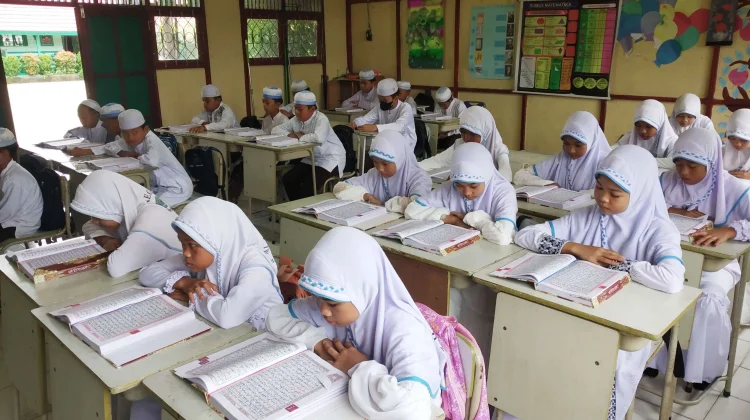
File Photo – Learning activities at state-run elementary Islamic School Madrasah Ibtidaiyah 11 Hulu Sungai Selatan, South Kalimantan. The Indonesian g...
KBRN, Jakarta – Minister of Religious Affairs Nasaruddin Umar has launched the Roadmap for Islamic Education as a strategic framework to develop Islamic education in Indonesia, to support the Golden Indonesia 2025–2045 vision.
He emphasized that the curriculum plays a decisive role in shaping the Muslim community and the character of future generations.
“The kind of community we hope for in the future can essentially be ‘ordered’ through the curriculum. Therefore, the curriculum is a very strategic instrument,” Nasaruddin said at the 2025 Islamic Education Review and Design forum in Jakarta on Tuesday, December 30, 2025.
The roadmap is built on Nasaruddin's Love-Based Curriculum, designed to be transformative. “It not only transfers knowledge, but also shapes the mindset, attitude, and relationships of humans with each other and with nature. We want to move away from a masculine and dominant perspective toward a nurturing approach that cares for and preserves life,” he explained.
He outlined five main directions of transformation within the curriculum. These include a theological shift toward a more humanizing approach, a reorientation from formality to substantive values, and a change in perspective from anthropocentric to eco-theological.
The fourth transformation is a shift from atomic to holistic thinking, while the fifth is a shift from formal religiosity to an awareness of diversity that fosters creativity. “Religion is not meant to restrict human creativity, but to serve as a moral compass that ensures humanity does not stray,” Nasaruddin said.
He stressed that Islamic education must produce an empathetic generation that upholds justice and cares for both humanity and the environment.
The curriculum, he added, must embody values of love such as empathy, sacrifice, forgiveness, and solidarity. “Education without love is not education. A curriculum that does not present love will lose its spirit,” he said.
Nasaruddin noted that the roadmap is not a final document but a continuous process that must be refined over time. He invited all stakeholders in Islamic education to work conceptually and contextually so that communities can genuinely benefit from the policy.
With national stability maintained, Nasaruddin expressed optimism that Indonesia has an excellent opportunity to build a superior and civilized Islamic education system.
The roadmap, he said, is expected to be a tangible contribution from the Ministry of Religious Affairs in preparing a quality generation for Golden Indonesia 2045. (Gusti Panji/Lasti Martina)





/tcjyrmg4m2jgcrx.png)
/97avpxiqfs48b8s.jpeg)