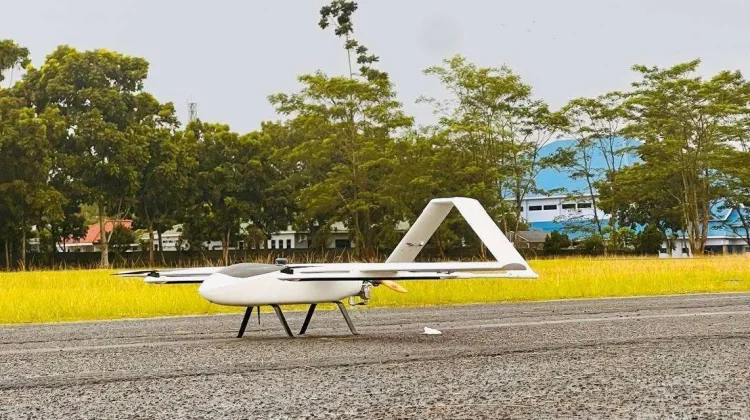
File Photo - LSU 02 VTOL, one of the unmanned aerial vehicles (UAVs) developed by BRIN. The agency conducted flight tests on four UAVs at Rumpin Air B...
KBRN, Jakarta: The Indonesian National Research and Innovation Agency (BRIN), through its Aviation Technology Research Center, carried out flight tests on four unmanned aerial vehicles (UAVs) at Rumpin Air Base, Bogor, West Java, from December 17–19, 2025. The tests aimed to evaluate flight performance and system reliability.
One of the aircraft tested was the LSU 02 VTOL, capable of vertical takeoff and landing without requiring a long runway. The test was conducted at an altitude of around 300 feet, flying at 53 knots for eight minutes.
“The flight test results show that the VTOL’s performance and systems are working as expected. This aircraft is designed for area surveillance and mapping missions,” said Danartomo Kusumoaji, Junior Researcher at BRIN’s Aviation Technology Research Center, in Bogor on Wednesday, December 24, as quoted on BRIN’s official website.
The second UAV, Alap-Alap, was tested to verify its autopilot system. It flew at an altitude of 800 feet for 30 minutes at a constant speed of 50 knots, demonstrating optimal automatic control.
Meanwhile, the Kresna aircraft underwent telemetry testing, transmitting flight data directly to the control station. It flew for 10 minutes at 300 feet and 50 knots, with stable data transmission throughout.
BRIN also tested the Skywalker aircraft to assess aerodynamic characteristics, including stability and responsiveness. Data from this test will be used to improve future aircraft design and performance.
Danartomo explained that the LSU 02 VTOL and Alap-Alap were fully designed and developed by BRIN, including their Flight Control Computer (FCC) technology. By contrast, the Kresna and Skywalker models used existing designs to support the research process.
“For Kresna, the design adapts the Cessna model to make FCC testing more accurate. Meanwhile, Skywalker is used to study aerodynamic parameters,” he said.
He emphasized that these flight tests mark an important step in advancing Indonesia’s drone technology. “Through these tests, we ensure that aircraft systems operate safely and efficiently to support mapping and surveillance needs,” Danartomo added. ***